
The quick answer? Probably not yet.
Most organisations have a chatbot. Some have a fancy dashboard that "does AI." But very few have actually deployed agentic AI: autonomous systems that don't just answer questions, but actually do the work. Book the meeting. Route the ticket. Reconcile the invoice. Make the decision.
There's a reason for that. Moving from a chatbot that suggests answers to an AI agent that executes tasks is not a software upgrade. It's an operational shift. And if your data, governance, and workflows aren't ready, your agents won't be either.
Here's the checklist we use at Marketways when consulting with UAE and GCC leaders on AI strategy. These five steps separate the organizations that pilot forever from the ones that actually deploy.
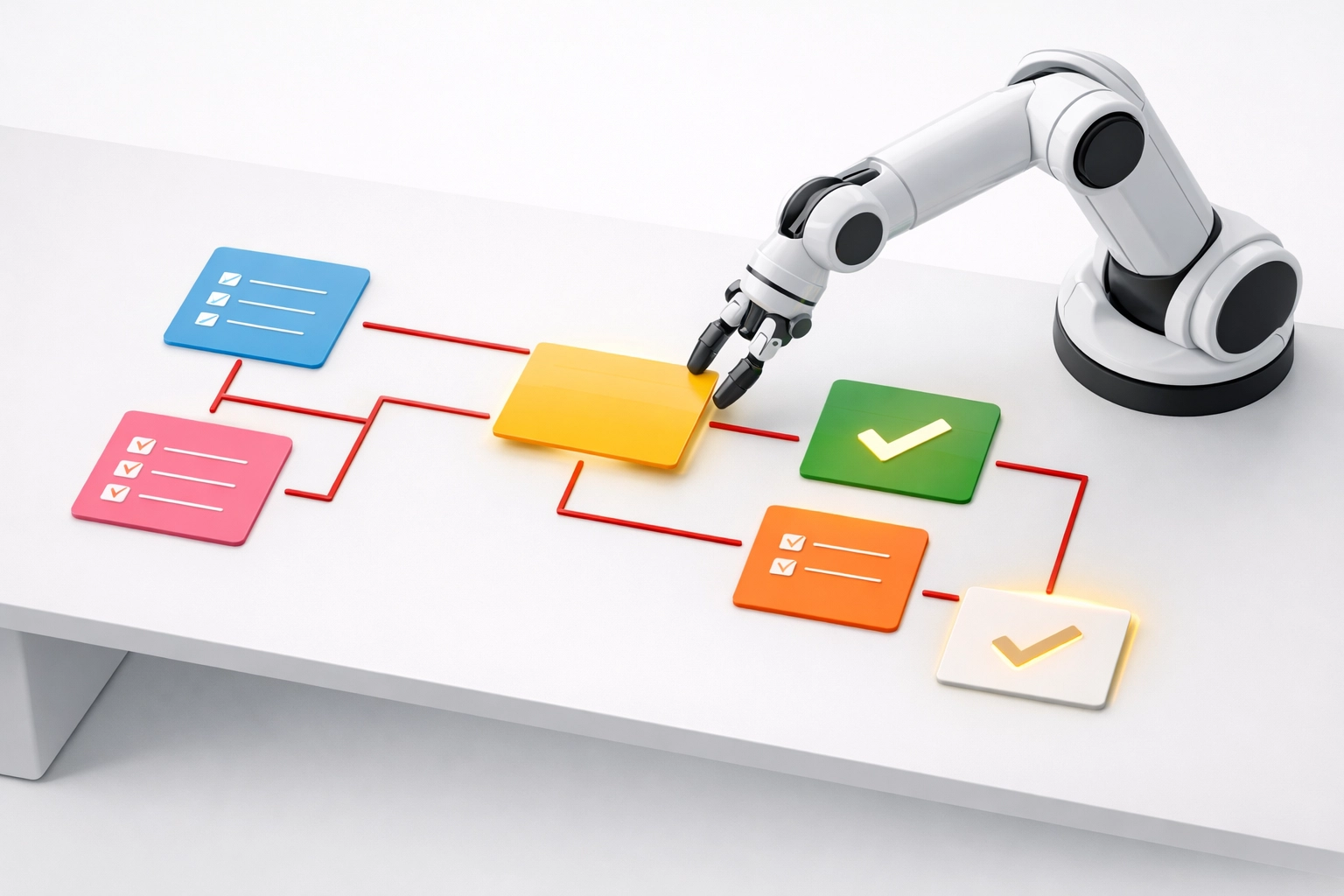
Step 1: Define Clear Objectives & Tasks (Not "AI for Everything")
The biggest mistake we see? Leaders who want to "deploy AI agents" without defining what those agents will actually do.
You don't need AI everywhere. You need it where your team is bleeding time.
Start with a workflow audit. Where do people lose 3+ hours a week doing repetitive, low-judgment tasks? Customer inquiry routing. Expense approval routing. Data extraction from emails or PDFs. Scheduling and follow-ups.
Pick one use case. Define what success looks like. Is it response time under 5 minutes? Cost per transaction down by 40%? Ticket backlog cleared within 24 hours?
When we frame an AI roadmap for clients, we use our Nine Level Framework to align AI initiatives with actual business metrics: not vendor promises. Strategic alignment isn't optional. If your AI agent doesn't move a KPI you already care about, it's a science project, not a business tool.
Step 2: Data Readiness & Tool Access (The Unglamorous Stuff)
Here's what no one tells you about agentic AI: it's only as good as the systems it can touch.
If your customer records are scattered across three CRMs, your financial data lives in outdated Excel sheets, and your internal documentation hasn't been updated since 2021, your AI agent will fail. Not because the model is bad, but because the foundation is broken.
Ask yourself:
- Is our data clean, consistent, and up-to-date across systems?
- Can the AI access the tools it needs: APIs, databases, internal platforms?
- Do we have a single source of truth for key entities (customers, products, transactions)?

My experience? Most companies skip this step. They assume "the AI will figure it out." It won't. A probabilistic model fed inconsistent inputs will produce inconsistent outputs. And when your AI agent books the wrong meeting or routes a high-value customer inquiry to the wrong team, you'll know exactly where it went wrong.
This is where data insights work becomes critical. Clean architecture reduces operational noise. It lets your AI operate with speed and accuracy instead of constantly second-guessing itself.
Step 3: Governance & Guardrails (Or: When the Agent Shouldn't Act Alone)
Let's talk about the uncomfortable part. Agentic AI makes decisions.
In some cases, that's fine. Auto-routing a customer email? Great. Scheduling a follow-up call based on CRM notes? Sure. But what about processing a refund? Escalating a legal complaint? Making changes to a high-value account?
You need to define where autonomy ends and human oversight begins.
We recommend a tiered approval model:
- Low-risk tasks: Full autonomy (e.g., scheduling, tagging, categorising).
- Medium-risk tasks: Autonomous execution with audit trail (e.g., basic customer requests).
- High-risk tasks: AI proposes, human approves (e.g., financial transactions, contract changes).
And obviously, compliance matters. If you're operating in the UAE or GCC, data privacy regulations (like GDPR for EU customers or local data residency laws) apply to AI decisions just as much as human ones. You'll need audit trails, explainability, and rollback mechanisms.
At Marketways, we integrate transparency and governance frameworks into every agentic AI deployment. If you can't explain why the AI made a decision, you can't trust it with real work.

Step 4: Monitoring & Feedback Loops (Because AI Doesn't "Set and Forget")
Here's the part most vendors won't emphasise: agentic AI isn't a project. It's a process.
Once your agents are live, you need continuous monitoring. Not just uptime monitoring (is the system running?), but quality monitoring (is the system doing the right thing?).
This means:
- Tracking key metrics: task completion rate, escalation rate, error rate, user satisfaction.
- Building feedback loops so frontline teams can flag when the AI gets something wrong.
- Reviewing edge cases and updating the model or ruleset accordingly.
We've built tools like BiasPulse and InfoTrack specifically for this. They monitor AI agent outputs in real time, flag anomalies, and help teams refine agent behavior before small errors become operational liabilities.
And here's the thing: your business changes. New products launch. Policies update. Customer expectations shift. If your AI agent isn't continuously learning and adapting (with human oversight), it becomes outdated fast.
The Nine Level Framework we use at Marketways includes ongoing calibration as a core principle. AI deployment isn't a finish line. It's a feedback loop.
Step 5: Human-in-the-Loop Integration (Collaboration, Not Replacement)
Let's clear this up once and for all: agentic AI isn't about replacing people.
It's about giving people leverage.
The best agentic AI deployments we've seen don't eliminate jobs: they eliminate busywork. Customer service reps stop routing tickets manually and start handling complex escalations. Finance teams stop chasing receipts and start analysing spending patterns. Analysts stop cleaning data and start building insights.

But this only works if you design the system for collaboration. That means:
- Clear handoff points where AI passes work to humans (and vice versa).
- Interfaces that let people review, approve, or override AI decisions easily.
- Training and change management so teams understand what the AI can (and can't) do.
The organisations that fail at agentic AI? They treat it like automation software: install it, walk away, expect magic. The ones that succeed treat it like a new team member: onboard it, train it, refine its role over time.
We've seen this play out across industries in the GCC. A logistics company we consulted with deployed an AI agent to handle shipment queries. The first month? Chaos. The agent couldn't handle edge cases, and the team didn't trust it. But after refining the handoff protocols and building feedback loops, the agent now resolves 70% of queries autonomously: and the team loves it because they only handle the interesting stuff.
Where the Marketways Nine Level Framework Comes In
At Marketways, we don't just help you deploy agentic AI. We help you deploy it right.
Our Nine Level Framework breaks down AI readiness across nine dimensions: from strategic alignment and data foundation to governance, monitoring, and continuous improvement. It's the difference between an AI pilot that impresses the board and an AI system that actually runs your operations.

Because here's the truth: agentic AI isn't a product you buy. It's a capability you build.
The vendors will sell you the model. The platforms will sell you the integrations. But the hard work: defining objectives, cleaning data, building governance, establishing feedback loops, training teams: that's on you. And if you skip any of those steps, your agents won't be ready for real work.
So, Are Your Agents Ready?
If you've made it this far and realised you're missing two or three of these steps, you're not alone. Most organisations are.
The good news? You don't have to figure it out alone. If you're serious about moving beyond chatbots and pilots, let's talk. We'll help you assess where you are, what's missing, and how to get your AI agents doing real work: not just real demos.
Because 2026 isn't the year of "AI hype." It's the year of AI execution. And execution starts with readiness.
